



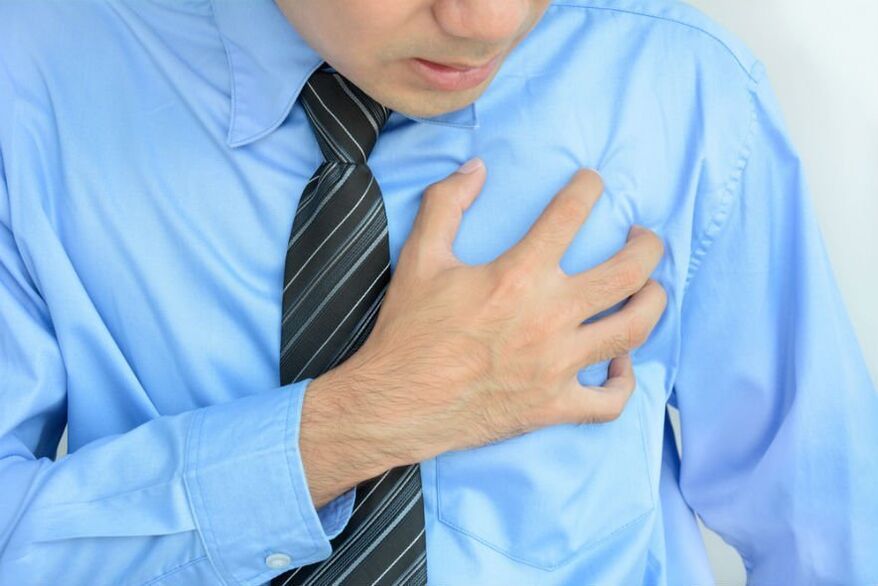
Painful sensations in the heart area force patients to consult a cardiologist.Anxiety, irritability and fear for one's own life arise.But not all unpleasant signs are directly related to heart problems.Even thoracic osteochondrosis - symptoms, sensation - pain in the heart provokes as often as diseases of this organ.
Pain behind the sternum, closer to the back or even the diaphragm, when the vertebrae are affected, can often occur, regardless of the stage of the pathology.And the mechanism of the unpleasant symptom has several functions.
Mechanism of symptom development
Interruptions in the heart during osteochondrosis cannot occur by themselves;they develop only as an echo of the underlying disease:
- Thinning of intervertebral structures.The distance between bone elements and cartilage is reduced, which leads to restriction of the nerve roots.As a result, painful sensations are formed, which, in the presence of destructive processes in the thoracic or cervical spine, often radiate to the heart.
- Changes in the heart muscle.Due to the disease, sensations spread throughout the heart muscle, the so-called "echoes" of pain.
- Involvement of the upper limbs in the process.The effect of osteochondrosis on the heart may be due to excessive muscle tension in the arms.As a result, pain is transmitted to the heart muscle, but the EKG shows no abnormalities.
- Changes in the structure of the lower back.The position of the abdominal organs changes, resulting in increased stress and changes in heart rate.
- Muscle spasms and changes in blood circulation.Pain in the heart with osteochondrosis occurs in response to changes in blood flow in the large arteries of the back.The heart rate increases when the blood has to be pumped through a narrower passage.
- Severe destruction of intervertebral discs.Nerves get pinched, leading to pain in the heart area.Hypoxia develops gradually.It also covers the functioning of the brain, as a result of which the usual functioning of the internal organs is changed.
- Due to compression of the arteriesand nerve fibers, high pressure can occur.Due to this, painful sensations arise in the heart.
You can distinguish pain in the heart from manifestations of osteochondrosis by certain symptoms.
Signs of osteochondrosis with painful sensations
Heart syndrome - pain in the heart due to osteochondrosis in the thoracic region - develops in many patients.Symptoms will have the following functions:
- pressing, dull pain in heart;
- gradually increasing discomfort, subdued, not too pronounced;
- pain persists for a long time, covers the chest, causes palpitations;
- there is no sharp pain intensity due to the destruction of cartilage between the vertebrae;
- Almost always, a symptom such as a feeling of heat behind the sternum helps to distinguish heart pain from osteochondrosis;
- heart medications (nitrates) do not help relieve pain;
- if a person begins to move his upper limbs, the pain intensifies.

If the cervical spine is involved in the process, then pain is felt in the vertebral area.
Some patients note that the pain is of a different nature: discomfort covers the left side of the sternum, affects the muscles, sometimes it spreads to the shoulder, neck and face, and the attack can last for several days.
If compression of the vertebral artery occurs, additional symptoms occur: weakness, dizziness, spots, and in severe cases, the patient loses consciousness.Also, with pain in the heart, there is a decrease in hearing and vision, and blood rushes to the face.If a person takes medicines for hypertension, they do not help him.
Differences in pain
There are several ways to distinguish heart pain from osteochondrosis;the main method is to undergo an MRI and ECG examination.In addition, you should know what happens with thoracic cartilage damage between the vertebrae and what does not happen with heart disease:
- the pain is moderate, increases and lasts for a long time.In heart attacks, the symptoms are more severe;
- if you press the chin to the chest, the pain of osteochondrosis will intensify;
- if the pain intensifies with movement and exercise, this is osteochondrosis;
- With heart pain, panic, fear and anxiety always arise.
Neuralgia itself is safe, but can be aggravated when the body is tilted in different directions or during sharp turns.You can relieve pain with analgesics.
Serious heart disease and osteochondrosis
You need to know how the heart hurts with osteochondrosis in the thoracic region, especially to distinguish neuralgia from life-threatening conditions.In chronic ischemic heart disease, the pain occurs very acutely, within 3-5 minutes.Sensations of an urgent nature do not allow breathing, and after nitrates the symptoms disappear immediately.
If the risk of myocardial infarction is high, remember that a person in this condition may lose consciousness, experience nausea and acute chest pain.The pain of osteochondrosis is never so acute.
But with VSD (dystonia) the symptoms can be similar.But unlike pain in the heart with osteochondrosis, a person with this pathology experiences tachycardia, bradycardia, a feeling of fear, quickly gets tired and feels constant weakness.The pain is usually aching and dull, and in osteochondrosis it is compressive.
Heart palpitations
With osteochondrosis, the heart can not only hurt, but also be bothered by angina pectoris, arrhythmia and tachycardia.This occurs due to spasm and compression of the artery.With osteochondrosis, the following features appear:
- increased heart rate at rest, increased rhythm during exercise;
- smooth rhythm without interruptions;
- wave-like heat attacks;
- tachycardia may be accompanied by presyncope.
The symptoms disappear if quality treatment of the disease is carried out.
Extrasystole
Extrasystole is a condition where there is a sensation of a second cardiac arrest.With osteochondrosis, this complication causes real panic.However, this unusual condition is the norm for the human body.True, most people do not notice such a process.
Extrasystole is a kind of "breathing space" in the work of the heart muscle.Surprisingly, such short breaks are essential for the organ.
Such "breaks" happen to people, regardless of their age, weight and daily physical activity.
Pressure in osteochondrosis
Among the symptoms of thoracic osteochondrosis is often high blood pressure.But this pathology can have other causes.With osteochondrosis, arteries, veins and blood vessels are compressed, and nutrition of the brain and other organs deteriorates.

Patients start taking medicine to solve this problem, as a result of which blood again stops flowing to the brain.Oxygen starvation and lack of nutrients develop.A person is troubled by symptoms such as: weakness, drowsiness, pain and dizziness, pale skin, nausea.
Coping with painful sensations
After it has been possible to distinguish heart pain from osteochondrosis, the treatment of diseases should be differentiated.If all the symptoms are associated with damage to the thoracic spine, no medicine can be taken to relieve the feeling of pain in the heart.
Therapy should eliminate the causes of osteochondrosis or minimize them.It is proven that regular, systematic treatment helps relieve tension, spasms and tension in nerve fibers.Since the heart and osteochondrosis are strongly connected, treatment should begin with the spine during an exacerbation:
- The person should not move much;bed rest is recommended.
- To relieve acute pain, NSAIDs or glucocorticosteroids are prescribed.
- Local medicine is also used, which is good for pain relief due to osteochondrosis.
- Physiotherapy helps in the early stages of the disease, but is rarely used to relieve pain.Only during the recovery period after an exacerbation.
- Manual therapy is a very effective method of restoring the vertebrae, relieving spasms, tension and swelling of surrounding tissues.
- Exercise therapy and sports useful for osteochondrosis in the thoracic region are also prescribed.
- In addition, you can use folk recipes - baths and compresses - they are very relaxing and have a positive effect on the emotional state of patients.
- An equally important diet in the treatment of osteochondrosis.Adequate amounts of plant foods, healthy fats and protein are essential to repair damaged tissue.A balanced diet also helps you lose excess weight.

The best way to determine whether osteochondrosis or the heart is bothering you is to undergo a medical examination.With the help of X-rays and a simple EKG, you can understand which sensations relate to a particular disease.